
Branding is the result of the decisions your business consistently makes over time. This includes decisions about who you serve and the quality you deliver. Decisions about people you bring in and how customers experience your business everywhere, whether offline on the streets, online on Instagram, on your WhatsApp DMs, or even right on your website.
What is Branding in Business?
Branding in business is the strategic process of building your organization’s image. It is the sentiment generated by the message, by the conversations, and by the interactions. Your brand is what people think about your organization, all shaped by the decisions you make over time.
It is not a one-time activity where you create a logo, print it on t-shirts, and do photoshoots. It goes beyond what you say about yourself in marketing and promotions to mean what you actually deliver and how your business is represented, everywhere.
That means every interaction a customer has with your business either strengthens or weakens your brand. Every employee who represents your company either reinforces or contradicts your brand promise. Every partnership you enter either elevates or dilutes your positioning, and every visual representation reinforces your identity.
7 Decisions That Build Powerful Brands
After examining both global and local brands such as Apple, Coca-Cola, McKinsey, Andela, Cowrywise, and Innoson Vehicle Manufacturing, I observed that the following seven decisions are practical choices that separate businesses that accidentally have a brand from businesses that deliberately build one.
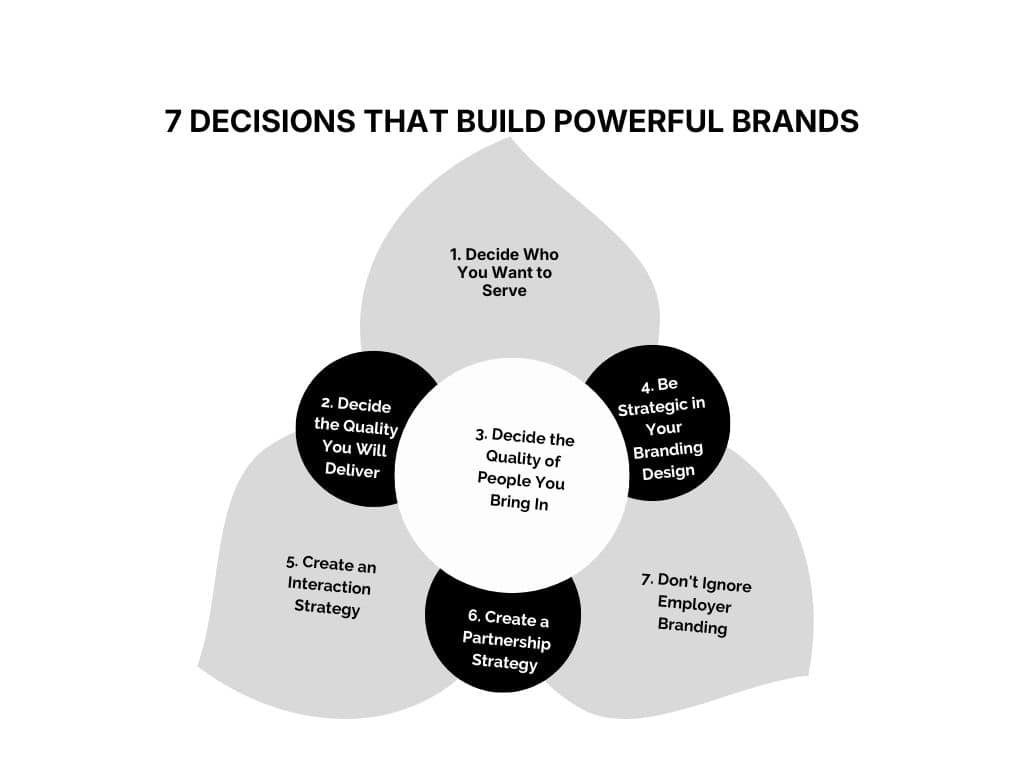
1. Decide Who You Want to Serve
This is the first and most basic branding decision, but, unfortunately, also the one most businesses rush past: who exactly are you building this for?
Author, Simon Sinek, puts it directly when he said “People don’t buy what you do; they buy why you do it.”
But here’s what I think: before you can even communicate your “why”, you need to be clear about who you are communicating it to.
If you try to serve everyone in Lagos State, for example, you end up addressing no specific need. Most general messages connect with no one deeply enough to create loyalty, unlike specific messages.
Look at Nigeria’s Innoson Vehicle Manufacturing, for instance. When they started out, it was pointless to compete with every global car brand that Nigerians were already using. They focused on vehicles designed for Nigerian roads and Nigerian conditions.
That single decision about who they were building for, shaped their entire identity, their product engineering, their marketing, and their positioning as a proudly African manufacturer.
Look at Flutterwave, also. Their focus was not simply “payments.” It was helping African businesses receive and send payments globally. That specific audience definition (African businesses operating in a global economy) gave them a clarity of purpose that differentiated them from generic fintech players.
Globally, Apple does not make products for everyone who uses a computer or mobile phone. They make products for people who believe that technology should be beautifully simple. That belief-based audience definition is why Apple customers do not just buy iPhones, they identify as Apple people.
Here at Score Mark, our focus is on SMEs who lack active and credible online presence, helping them communicate and display their credibility in the best way and maintain an online presence that attracts the right customers, is our goal.
So, where do you get started? If your brand could only serve one type of person, who would that be? Write that person down in specific detail, including their industry, their goals, their frustrations, their location. That is your starting point!
Watch the YouTube version of the 7 decisions that build powerful brands
2. Decide the Quality You Will Deliver
The second decision is about standards, and it is a decision that you must consciously make, because the market will make it for you if you do not.
What level of quality will people consistently experience every time they interact with your business? Not sometimes. Not when you are at your best. I repeat, consistently.
Remember, quality is not a slogan written on your company website. Quality is a habit you repeat so consistently that it becomes the expectation your brand carries.
Let’s look at the example of ShopRite. When they enter a new African market, customers already have an expectation of what the experience will be such as organised aisles, consistent product availability, and predictable pricing.
That consistency is a brand asset built through thousands of repeated quality decisions. So, when, for example, people experience product unavailability, you begin to hear things like “Oh, this doesn’t feel like Shoprite anymore!”
This applies to product businesses and service businesses equally. For service providers like marketing agencies, consultants, lawyers, accountants, quality delivery means consistent high-value output, clear communication, and reliable timelines. Every client experience becomes part of your brand story.
Our branding design services are built on this principle. For example, the visual identity we create for clients must reflect a quality standard that is consistent with the quality those clients deliver to their own customers.
3. Decide the Quality of People You Bring In
Many founders and business owners are so focused on building their product or service that they forget one of the most powerful branding decisions available to them: the people they bring into their business.
Your team is not just an operational resource. Your team is a living expression of your brand.
If companies do not actively work to keep clarity, discipline and consistency in balance, then trust starts to break down. – Simon Sinek
But that clarity, discipline, and consistency do not maintain themselves; they are maintained by the people inside the organisation, at every level.
This is why some businesses decide to hire only people with strong academic credentials, because academic rigour signals a certain standard of thinking.
Others prioritise hands-on industry experience, because practical capability is what their clients actually need. Some brands, particularly in creative and technology sectors, invest heavily in hiring for potential and training for skill, because they value adaptability over credentials.
None of these approaches is universally correct. But every one of them is a deliberate branding decision. The people you bring in, their values, their communication style, their professional standards, and their attitude toward clients collectively shape the experience your brand delivers.
This extends beyond full-time employees. The freelancers you work with, the agencies you partner with, and the collaborators you associate your name with are people decisions that carry branding implications.
Think about professional services firms like McKinsey or Andela. A significant part of their brand equity is built on the perception of who works there. The quality of their talent is inseparable from the quality of their brand. The same principle applies at every business level, whether you’re a small and growing business in Port Harcourt or anywhere across the world.
4. Strategic Branding Design
Now we arrive at what most people think branding is. And to be clear, visual identity matters enormously, even the government knows that.
In an article titled Branding government: how can good design help build public trust?, the UK government states that departments and agencies used to have their own logos, which were very varied in terms of design.
However, research on government symbols and brands, commissioned by the Cabinet Office, showed there was strong public support for using a government identifier.
People associated it with transparency and said it helped them feel more aware of what the government does. As a result, the government identity system was introduced in 2012 as a cohesive, consistent, and cost-effective approach to branding government organisations.
So, What is Branding Design?

Branding design is the visual and verbal expression of your brand’s identity. It includes your logo, colour palette, typography, design system, tone of voice, and the overall visual language your business uses consistently across different communication platforms.
The critical distinction is this: great branding design does not create your brand identity. It expresses the identity you have already built through the decisions you make on how you want to be perceived.
Your brand is a story unfolding across all customer touchpoints. – Seth Godin
Design is the visual language that tells your brand story clearly and consistently so that a potential customer seeing your Instagram post, your website, your business card, and your proposal document all receive the same consistent impression.
A local example that comes to my mind is Cowrywise, the Nigerian investment platform. Their design comes with clean interfaces, calm typography, soft greens and whites, and not the arbitrary feel usually associated with financial institutions. It directly reflects their brand promise: making investing simple, accessible, and trustworthy. When someone opens the app, the design immediately communicates safety and clarity before a single word is read.
Poor branding design is not just ugly. It is a misalignment between what you promise and what you signal. A luxury brand using cheap-looking typography contradicts its own positioning. A tech startup using a cluttered, outdated design signals that it is not as innovative as it claims.
Good branding design passes what Neumeier calls the gut-feeling test: when someone sees your brand, they should feel what you stand for before they read a single word.
If you need professional help building a visual identity that accurately reflects your business, our branding and design services are specifically built for SMEs who want a brand that builds instant credibility.
5. Create an Interaction Strategy
You do not build a brand by what you say about yourself. You build a brand by how people experience you, and every single interaction is an opportunity to either strengthen or weaken that experience.
Simon Sinek captures this precisely when he said: “Trust emerges when we have a sense that another person or organization is driven by things other than their own self-gain.” That sense of trust is built not through advertising but through repeated positive interactions that demonstrate genuine care.
Your interaction strategy covers the following touchpoints where a customer, prospect, or follower encounters your brand:
1. Customer service: How you respond when things go wrong is one of the most powerful brand-building moments available to you. If your business handles complaints with speed, empathy, and accountability, you’ll build more loyalty than a competitor that never has complaints.
2. Social media: How you engage with comments, questions, and direct messages shapes your brand’s perceived personality. A brand that responds warmly and helpfully to a confused prospect’s question is demonstrating its values in real time. You can manage consistency through a deliberate social media management strategy, not occasional posting.
3. Website experience: Is it easy for visitors to find what they need on your website? Does your page load fast? Do you have clear navigation? All of these are interaction moments that send a signal about your brand’s standards. Poor website experience is one of the reasons why most small business websites don’t convert.
4. Email and proposal communication: The quality of your written communication, your response time, and the professionalism of your documents all contribute to the brand experience.
Every interaction answers the same fundamental question in the mind of the person experiencing it: Is this brand worth trusting?
6. Create a Partnership Strategy
The sixth decision is about association, specifically, who you associate your brand with beyond employees.
Partnerships, collaborations, and affiliations send a powerful signal to the market. They communicate what level your brand operates at, what values you hold, and what community your brand belongs to.
Seth Godin argues that “brands are built around communities and shared beliefs.” Your partnerships are one of the clearest public declarations of which community your brand belongs to and which beliefs it holds.
Many African startups have strategically partnered with global companies specifically to accelerate their credibility. When Nigerian-based fintechs like Opay and Moniepoint partner with Visa or Mastercard, they are gaining technical infrastructure and borrowing credibility. The association signals: we operate at this level.
But the same principle works at every scale. A Port Harcourt business that is seen collaborating with respected local brands, speaking at industry events, or contributing to respected publications is building credibility through association.
Equally, a business that associates itself with low-quality partners or controversially positioned organisations absorbs some of that positioning into its own brand, whether it intends to or not.
Therefore, choose your partnerships deliberately. Ask: Does this association reinforce the identity we are building, or does it dilute it? Does this partner’s reputation elevate our positioning, or compromise it?
7. Don’t Ignore Employer Branding
The seventh decision is one that most small and growing businesses overlook entirely, and in 2026, it is becoming increasingly impossible to ignore.
What is Employer Branding?
Employer branding is how a company presents itself to both current and potential employees. It is the reputation your organisation builds as a workplace, shaped by your company culture, values, employee experiences, and the way you communicate them.
In plain terms, your employer brand is what people say about working for you. And in 2026, that conversation is happening publicly on LinkedIn, on Glassdoor, in WhatsApp groups, and in every industry community.
The data makes the stakes clear. According to research by CareerArc, 82% of candidates consider employer brand and reputation before applying for a job. And according to the Edelman Trust Barometer, employee voices are three times more credible than the CEO’s when talking about working conditions in a company.
This means your employees are already your most powerful employer brand ambassadors or your most damaging critics. The question is which.
How to Improve Employer Branding
Improving your employer brand is not primarily an external communications exercise. It begins internally with the actual experience of working in your organisation.
1. Define your Employee Value Proposition (EVP). What do you genuinely offer people who work with you? Beyond salary, what growth opportunities, what culture, what mission, what environment do you create for them? Be honest. A strong EVP is specific and authentic, not a generic list of clichés.
2. Involve your Team in Brand Communications. Research shows that posts shared by employees generate 800% more engagement than the same posts shared by official brand accounts. Encourage your team to share their work, their wins, and their experiences, particularly on LinkedIn. This is organic employer brand building at its most effective, and this can be achieved with engaging content marketing.
Read Also: Content Marketing ROI | What Small Businesses in Nigeria Can Realistically Expect
3. Make the Candidate Experience Reflect your Culture. 95% of candidates agree that the way a potential employer treats them as a candidate reflects how they would be treated as an employee. How you communicate during recruitment, how promptly you respond, and how respectfully you handle rejections all shape your employer brand.
Be consistent between internal and external. The most damaging employer brand failures happen when a company presents one face to the public and delivers a very different reality internally. Authenticity is not just a nice value; it is a strategic necessity.
For growing businesses competing for skilled talent in a tight market, employer branding is no longer optional. The best candidates have options. They research employers before applying. A strong employer brand means the best talent chooses you, rather than you having to convince them.
How to Do Branding of Your Website Through SEO
Your website is the single most important owned asset in your brand’s digital presence. And SEO, which means Search Engine Optimisation, is how you ensure that when potential clients search for what you offer, your brand is the one they find.
From your homepage writing to how you use your brand name and the quality of content you create, the connection between branding and SEO is deeper than most businesses realise. It is not just about ranking for keywords. It is about how Google and AI search systems perceive your brand’s authority, credibility, and relevance.
Here is how to build your brand through your website’s SEO:
1. Use your brand name as an anchor
Every page on your website should clearly identify who you are, what you do, and where you serve. Your page titles, meta descriptions, and headings should reflect your brand positioning, not just keywords. For example, for score Mark, “Best Digital Marketing Agency in Port Harcourt, Nigeria” is both an SEO signal and a brand statement.
2. Create content that reflects brand authority
Google rewards websites that consistently publish helpful, well-structured content that demonstrates genuine expertise. Every article, guide, and resource you publish is simultaneously an SEO asset and a brand credibility signal. Our content marketing services are specifically designed to build both simultaneously.
3. Apply schema markup to your website
Schema markup is structured code that tells Google exactly what kind of business you are: your name, location, services, and FAQs. It is one of the clearest technical signals you can send about your brand’s identity.
4. Build local brand authority
For Nigerian SMEs, local SEO is one of the highest-return branding investments available. Optimising your Google Business Profile, building consistent local citations, and earning reviews all reinforce your brand’s authority in your specific market.
5. Ensure brand consistency across your digital presence
Your website, social media profiles, Google Business Profile, and any directory listings should all use exactly the same business name, address, and contact information. Inconsistency confuses both Google and customers and inconsistency is the enemy of a strong brand.
6. Optimise for AI search
As more people use AI assistants to answer questions, brands that structure their content as clear, direct answers to real questions will appear more frequently in AI-generated responses. Write FAQ sections that answer questions the way real customers ask them. Use clear headings. Be specific about your location and expertise.
Conclusion
Every decision you make about who you serve, what quality you deliver, who you bring into your team, how you design your identity, how you interact with customers, who you partner with, and how you build your employer reputation, all of these decisions, repeated consistently over time, become your brand.
Marty Neumeier’s most quoted insight applies here perfectly: “Your brand isn’t what you say it is. It’s what they say it is.”
What do you want customers to say?
Start with the seven decisions above. Maybe, not all at once, but one at a time. And if you need a partner who understands both the strategic and practical dimensions of building a powerful brand for an SME business, we are here.
Score Mark helps businesses across Port Harcourt and Nigeria build credible, consistent brands that attract the right customers and earn lasting trust. Contact Score Mark today and let’s build something worth talking about.
References
1. Marty Neumeier: The Brand Gap Neumeier, M. (2006). The Brand Gap: How to Bridge the Distance Between Business Strategy and Design. New Riders Publishing. Available at: https://www.martyneumeier.com/the-brand-gap
2. Simon Sinek: Start With Why (TED Talk) Sinek, S. (2009). How Great Leaders Inspire Action. TEDxPuget Sound. Available at: https://www.youtube.com/watch?v=qp0HIF3SfI4
3. Edelman Trust Barometer Edelman. (2024). Edelman Trust Barometer: Trust in the Workplace. Edelman Intelligence. Available at:https://www.edelman.com/trust/2024/trust-barometer
4. CareerArc: Employer Branding Study CareerArc. (2023). The Employer Brand Research Report. CareerArc Employer Branding. Available at:https://www.careerarc.com/employer-branding-study

This is a great article highlighting how the right strategic decisions can shape a strong and memorable brand. Clear positioning, consistent messaging, and a deep understanding of customers are essential for long-term success. A strong b2b brand identity also helps businesses communicate their value clearly, build trust with clients, and stand out in competitive markets. These decisions can make a meaningful difference in building lasting brand growth.
This is an insightful article that explains how important branding decisions can shape a strong and memorable business. The points about positioning, consistency, and communication are especially useful for building customer trust. A clear step by step guide can
help businesses present a professional image, connect with the right audience, and stand out from competitors. Strong branding can ultimately create lasting recognition and support long-term business growth.