A few days ago, I was sitting across from the founder and chief engineer at FOJ Information Systems Services Limited, a local office equipment dealer in Port Harcourt, Nigeria. He had reached out to Score Mark Enterprises for a website upgrade and product update plan. He had gladly accepted my suggestion to also set up the brand’s Google Business Profile, which they currently do not have, as I write.
But the moment I mentioned content marketing, specifically adding valuable blog articles to the website, he made a face that said, “Nah, that isn’t for me.”
What followed was an avalanche of questions that I honestly didn’t expect from someone who runs a business in 2026:
“Do people still read blog articles in 2026?”
“How do you measure the impact?”
“Can you explicitly tell me how much money a piece of content can help me make in a month or at least a certain period?”
His honesty was refreshing, though. Because the truth is that most Nigerian business owners carry these exact same questions, but many are too proud to ask them. They either invest in content blindly or refuse to, without ever really understanding what they should be getting back.
So this article is my honest answer to a client based on content marketing return on investment questions. I’ll discuss what content marketing ROI actually looks like for Nigerian SMEs and when you can realistically expect to see it.
First, Why Are Nigerian Business Owners Sceptical About Content Marketing ROI?
Nigeria has more than 41 million micro, small, and medium enterprises (MSMEs), according to the Small and Medium Enterprises Development Agency of Nigeria (SMEDAN). These businesses operate in a challenging environment facing inconsistent infrastructure issues, rising operational costs, and tightening customer budgets. Survey shows that MSMEs contributed 46.32% to GDP and accounted for 87.9% of employment in Nigeria. They are, in every sense, the engine of this economy.
And yet, because so many digital content creators in Nigeria post for posting’s sake, a large number of SME owners have concluded that content marketing is noise. That perception is understandable because people go into business to make money, not to waste it. But it is also costing Nigerian businesses real money, which is why it’s good to know the best digital marketing strategies for Small Businesses in Nigeria when launching online.
Content Marketing ROI: What I Have Seen on Real Projects
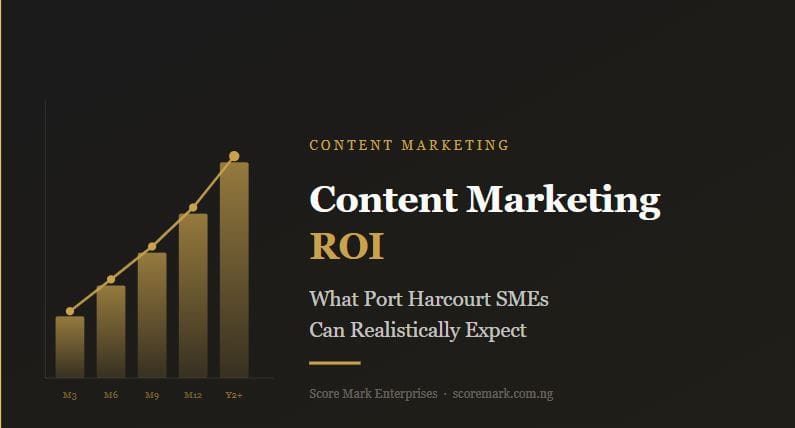
When the founder of FOJ Information Systems Services Limited asked me, “How much can a piece of content make me in a month?” the honest answer starts with a reframe: content marketing does not pay you in month one. It pays you in months and years, say one to two, three, and four years, often from work you did and forgot about.
Here is what I have actually observed: the first six months are mostly invisible. Google is crawling, indexing, and deciding whether your content deserves to rank. There is activity happening, but it does not feel like ROI yet. Business owners who quit during this window almost always cite “it’s not working” without realizing they abandoned an investment one quarter before it would have started compounding.
The inflection point tends to arrive somewhere between months seven and twelve, and when it does, it arrives quietly. A procurement officer in GRA Port Harcourt searches for something specific, finds your article, reads it, and calls. A school bursar in Rumuola is comparing suppliers, and your blog post answers a question your competitor’s website does not. That is what measurable ROI looks like in this market: not a dashboard number, but a phone ringing from someone who already trusts you before you pick up.
But then, I’ve also seen results after 3 months with good search engine optimization (SEO). Mind you, how quickly you see results can also depend on the level of competition in your industry. And if you’re a local business with better SEO than other businesses in your area, you are likely to see results faster if your content is unique, valuable, and authoritative.
What Nigerian Businesses Can Realistically Expect From Content Marketing?
Let us apply this directly to a business like FOJ Information Systems Services.
This business sells and services office equipment in Port Harcourt and major Nigerian cities. His potential customers, who are office managers, procurement officers, startup founders, and school administrators, are searching online for answers to questions like:
“Best photocopy printer machine in Port Harcourt.”
“How often should I service a laser printer?”
“Where to buy office equipment in Rivers State”
If FOJ published two quality articles per month targeting these exact questions for twelve consistent months, here is a conservative picture of what could happen:
By month nine, the website could be receiving 500 to 1,000 organic visitors per month from Google, at an industry-average 2% conversion rate for well-optimized content, which represents 10 to 20 inquiries per month from organic search alone, without any ongoing ad spend.
If just three of those inquiries convert into paying customers at ₦200,000 each in equipment sales or service contracts, that is ₦600,000 in revenue from organic leads in a single month, against a monthly content investment that could be as low as ₦10,000 to ₦50,000, depending on scope.
This is illustrative, not guaranteed. But it demonstrates exactly how content marketing shifts from a cost to a compounding asset as it matures.
Content Marketing Opportunity Most Nigerian SMEs Are Ignoring
Here is something I want every SME owner reading this to understand.
Nigeria’s internet usage reached 13.2 million terabytes in 2025, a 35% increase over 2024, according to the Nigerian Communications Commission (NCC). Broadband penetration crossed 50% for the first time in November 2025. More Nigerians are online, for longer, consuming more content than at any point in our history.
And yet, the vast majority of SMEs in Port Harcourt and across Rivers State, for example, have no consistent content presence whatsoever.
That is an open field. If your business hires the right content writer who starts building strategic content now by answering real customer questions, demonstrating expertise, and appearing in Google and AI search results, it will occupy positions that become exponentially harder to dislodge over time. The businesses that wait will find themselves trying to compete against established content archives years from now.
This is not a prediction. It is already happening in other Nigerian cities. The gap between content-active and content-passive businesses in Lagos and Abuja is already visible in search results. Port Harcourt is slightly behind, which, right now, is actually an advantage for early movers.
Factors That Can Affect Your Content Marketing ROI?
Not all content marketing performs the same way. Here are the variables that matter most in the Nigerian context:
1. Local competition online
Most SMEs in Rivers State are not doing serious, strategic content marketing. This makes the digital field more open than it appears, particularly for businesses targeting a South-South Nigerian audience.
2. Publishing Consistency
Content marketing rewards regularity above almost everything else. A business that publishes two quality articles per month for twelve months will dramatically outperform one that publishes twenty articles in a burst and then stops. This is because Google’s algorithm favours regularly updated websites and so does your audience.
3. Content Quality and Commercial Intent
Generic content produces generic returns. Articles that target specific buyer questions, are properly researched, and include clear next steps consistently outperform content written simply to fill a calendar. If you have already tried this with no results, learn more on Why Your Business Blog Is Not Generating Leads and How to Fix It.
4. Website Performance on Mobile
Nigeria’s Nigerian Communications Commission data shows over 140 million active internet subscriptions, the vast majority accessed via mobile devices. If your website loads slowly on a smartphone, your content marketing investment is being undermined before a reader finishes your first paragraph.
5. Distribution Effort
Creating content is only half the job. On social media specifically, I always recommend repurposing content into native posts rather than sharing blog links. Zero-click is a real phenomenon moving people from one platform to another is increasingly difficult. Serve native content that the algorithm favours, and use your blog as the SEO engine it was designed to be.
How to Measure Your Content Marketing Performance
Franklin’s question, “How do you measure the impact?” is the right one to ask before investing.
Most measurement guides will hand you a list: track organic sessions, bounce rate, time on page, and form submissions. That is all valid. But in the Nigerian SME context, where WhatsApp closes more deals than any CRM, where clients call rather than fill forms, and where the customer journey often jumps between Instagram, Google, and a face-to-face visit, analytics dashboards only capture a fraction of what content is actually doing for your business.
The most reliable measurement tool I have encountered costs nothing: ask every new client, “How did you find us?” Write the answer down every single time.
At a previous workplace, this question alone revealed that prospects were finding us through AI platforms like ChatGPT not just Google. That single data point shifted our entire content strategy. If your new clients are consistently saying they found you through a search or read your blog, your content is working regardless of what your bounce rate says.
The Question Nobody Answers About Content Marketing ROI
Most content marketing articles will tell you to “use both” content for the long term, ads for the short term. That is true in theory, but it sidesteps the real question Nigerian SMEs are asking: when budget is tight, what do I do first?
Here is my honest answer from watching businesses navigate this in Nigeria:
If you have zero digital presence, I mean, no Google Business Profile, no website, no content, a small paid ads budget buys you visibility while your content foundation is being built. But ads without content are a leaking bucket. Every naira you spend on ads drives traffic to a website or profile that gives people no reason to trust you over your competitor. You pay for the visit and lose the sale because there is nothing to read, nothing to build confidence, and nothing that says “we know what we are talking about.”
Content without any promotion, on the other hand, is a slow burn that most SMEs cannot emotionally sustain long enough to see results.
Watch my video on how to set up your business successfully to learn more about the importance of content in business.
What actually works and what I have seen work is a sequenced approach. Build the content foundation for three to six months. Then layer targeted ads on top of a website that now has substance. Your ads become dramatically more effective when they send people to an authoritative, content-rich destination rather than a brochure website. The content does not just generate organic leads, it makes every naira you spend on ads go further.
The Techcabal Creator Economy report has pointed to the Nigerian creator economy potentially reaching billions of naira in value by 2030. The businesses that are building content infrastructure now are positioning themselves to benefit from that growth, not chase it from behind.
Related article: SEO Marketing in 2026: New Rules, AI Impact, and How to Stay Ahead
Content Marketing ROI FAQs
Do people still read blog articles in 2026?
Yes. More than ever. Because now AI search platforms like ChatGPT, Perplexity, and Google AI Overviews pull answers from well-written, authoritative articles. Your blog is now for both human readers and the AI systems that millions of people are now using to find products and services. Take, for example, here at Score Mark Enterprises, we receive visitors who read our articles on different days of the month and go as far as leaving comments behind. Also, content marketing in 2026 is beyond blog articles. It covers both blog articles and social media content such as BTS, UGC, social proofs, influencer content, and more.
How do you measure the impact of content marketing?
You can measure the impact of content marketing by tracking organic traffic, enquiry sources, conversion rate, and ask every new client how they found you. That question alone is worth more than most analytics tools.
Can you tell me how much money a piece of content can help me make?
A single well-optimised article can generate enquiries for three to five years. If one article brings in even two new clients per year at ₦150,000 each, that article has generated ₦300,000 annually from a one-time investment of perhaps ₦10,000 to ₦50,000 in writing and optimisation. That is the kind of ROI that makes content marketing the engine of the digital age. The Nigerian SMEs that understand this are investing in content marketing and reaping the long-term benefits.
Want to See What This Could Look Like for Your Business?
If you are a Nigerian SME owner with the same questions Franklin had, the next step is understanding what is realistic for your specific industry and audience.
You can explore our content marketing services for Nigerian SMEs or read how we think about why most business blogs fail to generate customers.
If you are ready to start a conversation, reach out at grow@scoremark.com.ng.