
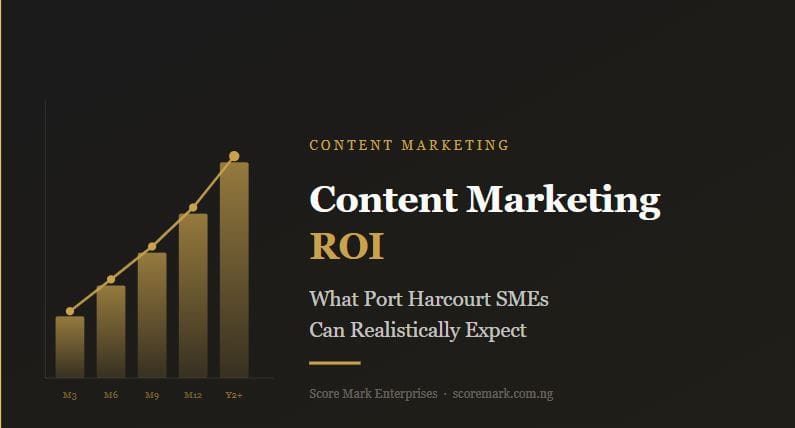
Content Marketing ROI: What Small Businesses in Nigeria Can Realistically Expect
Before any smart business owner invests in marketing, they want to know what they are getting back (Return On Investment). Here is an honest, data-backed picture of what content marketing ROI actually looks like for Nigerian SMEs, with reference to Port Harcourt.
Quick Answer
Content marketing ROI for Nigerian SMEs typically becomes measurable between months 6 and 12. Blog content takes 3 to 6 months to rank; then leads follow. Content marketing generates over three times as many leads as outbound marketing at 62% lower cost (Content Marketing Institute). A single well-optimised article can continue generating enquiries for 3 to 5 years.
Content Marketing ROI Is Beyond Sales
Return on investment in content marketing is broad. Unlike paid advertising where you can directly trace a sale to a specific ad, content marketing generates value that compounds over time:
- It gives you organic search traffic where people find your business through Google without paid ads
- Helps you build brand authority and you’re seen as the trusted expert in your field
- You get to generate leads when readers convert into enquiries and consultations
- With content marketing, you educate customers, shortening your sales cycle because prospects arrive already informed
- It helps referral growth especially when your content gets shared and recommended
Well, not exactly. A Facebook ad, for example, stops working the moment you stop paying for it. A strong blog article that is properly optimised keeps working potentially for years after the writing fee has been recovered.
According to the Content Marketing Institute’s 2025 research, content marketing generates more than three times as many leads (potential customers) as direct marketing and costs 62% less [1]. For Nigerian SMEs working with limited budgets, this ratio matters enormously.
Realistic Content Marketing ROI Timelines for Nigerian SMEs
One of the most common sources of disappointment with content marketing is unrealistic expectations about timing. Here is an honest breakdown:
| Timeline | What to Expect | Key Metric |
|---|---|---|
| Months 1–2 | Content strategy developed, first articles published, initial indexing by Google | Setup and baseline |
| Months 3–4 | First organic traffic begins; social sharing picks up; email list starts growing | Traffic and engagement |
| Months 5–6 | Google rankings begin to improve; first organic leads appear | Rankings and first leads |
| Months 7–12 | Compounding effect becomes clear; consistent lead flow from organic channels | ROI becomes measurable |
| Year 2+ | Significant organic authority built; cost-per-lead decreases steadily over time | Long-term compounding ROI |
These are not guarantees because results depend on your industry’s competitiveness, publishing consistency, and the quality of strategy behind the content. But this timeline reflects what I’ve seen most dedicated, well-managed content marketing efforts produce.
What Affects Content Marketing ROI for Nigerian Businesses?
Your Industry and Local Competition
A business in a niche market with few local competitors online will see results faster than one in a saturated space. Here is the hidden advantage many Port Harcourt SMEs, for example, are missing: most local competitors are not doing serious, strategic content marketing. The digital field is more open than it looks, particularly for businesses targeting Rivers State and South-South Nigeria specifically.
Publishing Consistency
Content marketing rewards consistency above almost everything else. A business that publishes two quality articles per month for 12 months will dramatically outperform a business that publishes 20 articles in one burst and then stops. Google’s algorithm favours sites that are regularly updated. So does your audience.
Quality and Commercial Intent
Low-quality, generic content produces low returns. That’s a lesson I learned the hard way! Content that targets specific buyer questions, is well-researched, and includes clear calls to action consistently outperforms content written just to fill a publishing calendar.
Distribution Effort
Creating content is only half the job. Businesses that actively promote their content through social media, email newsletters, and partnerships amplify their results significantly. Content that sits on your website unseen generates no leads, no matter how well written.
However, for social media, I always recommend repurposing content against sharing your blog links. This is because zero-click is a reality and moving people from one platform to another is becoming increasingly difficult, especially for content like blog posts. It is much better to serve native content which algorithms also favour.
Website Quality
Even the best content underperforms on a slow, hard-to-navigate website. Over 84% of internet traffic in Nigeria comes from mobile devices [2]. If your website does not load fast on mobile, your content marketing efforts are being undermined before a reader even finishes your first paragraph.
How to Actually Measure Your Content Marketing ROI
- Organic search sessions
- Page views per article
- New vs returning visitors
- Average session duration
- Time on page
- Bounce rate
- Social shares
- Comments and replies
- Form submissions from blog posts
- Calls mentioning your blog
- Email sign-ups from content
- Clients acquired via organic search
Always ask every new client: “How did you find us?” At my former place of work, this was how we got to learn that people were finding us on AI platforms like ChatGPT. This single question will tell you more about your content marketing ROI than any analytics dashboard. If clients are consistently saying they found you through a Google search or read your blog, your content is working.
— Chijindu Nwankwo, Content Manager, Score Mark EnterprisesA Realistic ROI Scenario for a Nigerian SME
Illustrative Scenario
A services business in Nigeria invests in content marketing, publishing two quality articles per month for 12 months. Monthly investment: approximately ₦80,000 to ₦150,000 depending on scope and agency.
By month 9, their website is receiving 600 to 1,200 organic visitors per month from Google. At a 2% conversion rate, which is the industry average for well-optimised content according to Statista, that represents 12 to 24 enquiries per month from organic search alone, without any ongoing ad spend.
If three of those enquiries convert into paying clients at ₦200,000 each, that is ₦600,000 in revenue from organic leads in a single month, against a monthly content investment of ₦100,000.
This is illustrative, not guaranteed. But it demonstrates how content marketing shifts from a cost to a compounding asset as it matures.
Is Content Marketing Worth It Compared to Social Media Ads?
| Factor | Content Marketing | Social Media Ads |
|---|---|---|
| Time to results | 3 to 12 months | Days to weeks |
| Cost over time | Decreases as content compounds | Stays constant or increases |
| Longevity | Content works for years | Stops when you stop paying |
| Trust building | Very high | Moderate |
| Best for | Long-term growth and authority | Short-term campaigns and promotions |
The smartest Nigerian SMEs use both; ads for immediate visibility, content marketing for long-term organic authority. But if budget is limited, content marketing delivers better long-term value per naira spent. According to HubSpot’s 2026 State of Marketing Report, website, blog, and SEO remains the number one ROI-generating channel for marketers [3] ahead of every paid channel.
Questions About Content Marketing ROI in Nigeria
Read the Full Content Marketing Resources
Want to know what ROI is realistic for your specific business?
Score Mark works with Nigerian SMEs to build content systems designed to generate measurable leads.
Sources & References
- Content Marketing Institute (2025). B2B Content Marketing Benchmarks, Budgets, and Trends. contentmarketinginstitute.com
- Statista / DataReportal (2024–2025). Nigeria mobile internet traffic share. datareportal.com
- HubSpot (2026). State of Marketing Report 2026. hubspot.com
- Statista (2025). Average e-commerce conversion rate. Referenced in hubspot.com/marketing-statistics
- DemandSage (2026). Content Marketing Statistics 2026. demandsage.com